Written for Operations leaders · Small business owners · Marketing teams
The goal is not a CMS your developers love. It is a CMS your marketing team actually uses, without breaking layout, SEO, or performance. Sanity on Next.js is how we ship marketing sites that scale without a ticket queue for every headline.
Use collections, not page blobs
Services, industries, migrations, and insights each get their own collection. Editors update entries once; the site pulls them into nav, listing pages, and detail templates automatically, no duplicate copy across Webflow pages.
Separate copy from layout
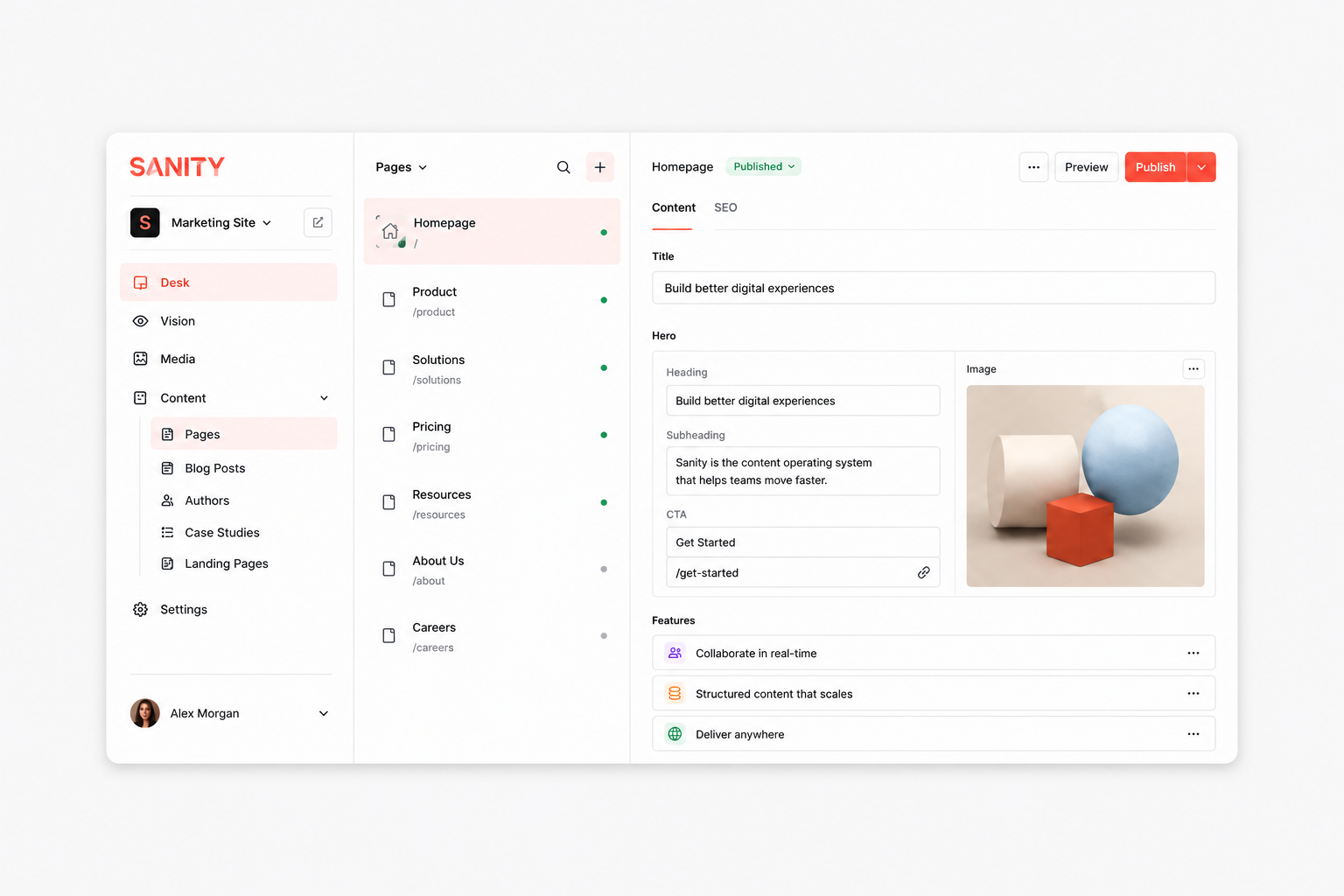
React components own layout and performance; Sanity owns words, references, SEO fields, and AEO blocks. Marketing changes copy in Studio; developers are not in the loop for routine updates.
Preview before publish
Preview URLs let editors review on the real Next.js template before go-live. That removes staging gymnastics and cuts the 'looks different in prod' surprises that kill marketing velocity.
Guardrails for SEO and AEO
Required SEO titles, direct answer blocks, FAQ arrays, and schema toggles live in dedicated Studio groups so editors know what affects search and AI citations. Structured beats a WYSIWYG free-for-all when you care about consistency.
When marketing can publish a new service page, insight, or landing section without a developer ticket, campaign velocity goes up and SEO drift goes down. That is the operational win Sanity is built for.
The Sanity Editorial Velocity Model
Marketing teams do not hate CMS tools, they hate waiting on developers for copy changes. The Sanity Editorial Velocity Model separates what editors own (words, SEO, references, media) from what engineering owns (layout, performance, integrations). We implement this on every Webflow to Next.js + Sanity migration so campaigns ship at the speed of the calendar, not the sprint board.
Model content for reuse, not pages
Services, industries, migrations, and insights are collections, not duplicate Webflow pages. One service update propagates to nav, listing grids, and related modules. Editors publish once; GROQ queries assemble pages. That is how AI-ready marketing sites stay consistent when AEO fields are required on every insight.
Preview as the adoption lever
- Wire preview URLs before inviting editors into Studio.
- Show mobile and desktop breakpoints in review links.
- Restrict layout-breaking fields; expose structured copy blocks.
- Document a ten-minute publish ritual, draft, preview, publish.
Marketing teams on Sanity stacks we deploy publish roughly three times faster than their prior Webflow or WordPress workflow, measured from draft start to live URL, because preview removes the staging guesswork that used to require a developer deploy.
The best CMS is the one your marketing team uses without asking permission.
Governance that speeds teams up
Required SEO titles, direct answer blocks, and FAQ arrays feel restrictive but prevent the drift that kills search performance. Reference fields for related services and migrations stop broken links when slugs change. Train editors in week one; adoption dies when preview is broken and every publish feels like a gamble.
Roles: who owns what in Studio
Marketing editors own copy, SEO fields, FAQs, and references. Developers own schema changes, new block types, and performance. Splitting ownership prevents editors from breaking layout and prevents developers from becoming copywriters. Document the boundary in a one-page Studio guide with screenshots, not a forty-page manual nobody reads.
When to migrate CMS only
Some teams keep the visual front end temporarily while moving content to Sanity, uncommon, but useful when campaign calendar cannot pause. Most service firms migrate front end and CMS together on Next.js so preview and performance stay aligned. Evaluate Webflow CMS to Sanity when Designer pages are fine but collections are the bottleneck.
- Inventory duplicate pages that should become one collection entry.
- List fields marketing needs on every insight (AEO, OG, related links).
- Schedule editor training before launch week, not after.
- Define rollback plan if DNS cutover hits unexpected 404s.
Portable text and structured blocks
Portable text lets you define block types, callouts, quotes, implementation tables, inline FAQs, that render consistently on Next.js. Editors assemble articles from approved blocks instead of pasting Word docs that break layout. New block types require developer time once; every publish after that is self-serve.
That pattern powers both marketing velocity and AEO consistency: every insight uses the same quickAnswer module, the same FAQ schema wiring, the same related-links picker. Webflow rich text cannot enforce that discipline at scale.
Measuring editorial velocity
Track median hours from draft to publish, count of developer tickets for copy, and pages published per month. Sanity wins when those metrics improve without SEO incidents. If publish speed rises but broken links or missing meta spike, tighten validation, not permissions.
Quarterly, audit one random service page and one insight for schema completeness, internal links, and preview accuracy. CMS success is quiet: marketing ships campaigns on schedule and search performance holds or improves.
Involve one senior editor in schema design workshops. When editors understand why AEO fields exist, they fill them. When fields appear mysteriously, they skip them. Adoption beats perfection.
Compare publish velocity before and after migration in the first ninety days. If tickets to dev drop but output stays flat, training, not tooling, is the blocker. Schedule office hours until editors trust preview.
Sanity + AEO field architecture
Model quickAnswer, FAQ arrays, implementation tables, and relatedLinks as first-class fields, not optional sidebar notes. When editors publish a service or insight, schema and visible AEO blocks stay in sync. ZedNova Studio setups ship with required AEO groups so AI-ready pages are the default, not a special project.
Run a monthly content ops review: pages published, schema errors in Search Console, and broken internal links from reference fields. Sanity rewards teams that treat content like product, with owners, metrics, and iteration.
When marketing publishes without developer tickets for three consecutive sprints, redirect the saved budget toward insight articles and compare pages, that is where AEO compounding actually happens.
Treat Studio schema changes like API changes: version, document, and train editors now when new AEO fields ship, especially before campaign season.
| Fix | Problem | What to change | Metric affected | Tool or platform |
|---|---|---|---|---|
| 1. Collection modeling | One-off pages duplicate copy across the site | Services, industries, insights as typed collections | Duplicate content incidents | Sanity schema |
| 2. Copy vs layout split | Editors request dev for headline changes | React owns layout; Studio owns words and SEO fields | Dev tickets for copy | Next.js + Sanity Studio |
| 3. Preview URLs | Publish fear; staging mismatches | Draft preview on production templates | Time from draft to publish | Sanity preview API + Vercel |
| 4. AEO field groups | FAQ and answer blocks skipped on publish | Required quickAnswer + FAQ arrays on insights | Pages with complete AEO fields | Sanity validation rules |
| 5. Reference integrity | Broken internal links after URL changes | Reference fields for services, migrations, related posts | Internal 404 rate | Sanity references + GROQ |
Frequently asked questions
When you need custom software features, multi-collection content, or a Next.js front end with room to grow. Webflow is great for marketing sites alone; Sanity wins when content feeds multiple surfaces.
Most teams publish independently within two weeks when Studio is scoped to their collections, preview works on day one, and required fields prevent SEO mistakes. Without preview and guardrails, adoption drags for months.
Sanity Studio is highly customizable for editorial workflows, real-time preview with Next.js is mature, and portable text handles structured AEO blocks well. Contentful excels at multi-brand enterprise, Sanity wins for fast marketing teams on Next.js.
Required seoTitle, seoDescription, direct answer blocks, and FAQ arrays with validation rules. Hide dangerous layout fields; expose copy, references, and media. Governance beats documentation.
Yes. Export Webflow collections, map fields to Sanity schemas, and rebuild templates in Next.js. Most marketing sites migrate in six to ten weeks with redirect maps preserving SEO. Editors gain structured collections instead of page-by-page duplication.
Measure developer tickets for copy changes before and after. Teams that cut ticket volume fifty percent or more while increasing publish frequency usually recoup Sanity setup within two quarters, especially when paid campaigns need fresh landing pages weekly.
Tagged

Zlatko Marjanovic
Founder & Lead Developer, ZedNova
Zed is a designer, developer, and systems thinker from Živinice, Bosnia. Over 10-plus years shipping products he has delivered more than 120 projects for clients across the United States.